Blog

All itemsSustainable businessSustainable transportSaving energyCanopiesHome batteryPreservingLaws and regulationsSolar panels
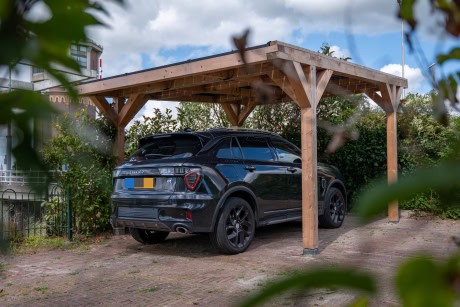
Sustainable wooden electric car parking space with solar panels and charging points.

A wooden or steel carport with solar panels: which one suits your home?

10-11-2026 Shift to Solar Are you thinking of installing a carport with solar panels, but can’t decide between timber and steel? Timber has a warm, natural look, whilst steel often has a more streamlined appearance and generally requires less maintenance. Both materials can be suitable for a solar carport, but they also differ in terms of structural possibilities. Which design best suits your home depends on your preferences and the space available on your driveway. In this blog, we’ll help you weigh up the differences. Wooden and steel carports: the key differences Wood and steel each have their own characteristics. The table below shows the key differences and points to consider. Component Wooden carport Steel carport Appearance Warm and natural Often sleek and modern Maintenance Depends on the type of wood, treatment and finish Generally low-maintenance with a suitable protective finish Lifespan Moisture control, the type of timber and maintenance are key considerations Corrosion protection and the condition of the finish are important Construction Beam dimensions and support points depend on the design Relatively slender supporting structures are possible in some designs Costs may also vary. In addition to the material, factors such as dimensions, construction, finish, foundations, solar panels and installation all play a role. Wood is therefore not automatically cheaper than steel, or vice versa. Both materials may be suitable for a carport with
Read more
Battery storage for a solar carport with a parked car in Weert

No additional network capacity: how can you still expand your business in 2027?

27-10-2026 Shift to Solar You want to install an extra machine in 2027, charge more electric company cars or electrify your production. But the grid operator cannot make any additional capacity available. Does that mean your plans have to be put on hold? Not necessarily. By making better use of existing capacity, space for expansion can be created. What works depends on your electricity consumption, the new installations and their operating times. According to the ‘State of Implementation’ report by Netbeheer Nederland, as at 30 June 2026, regional grid operators had 15,498 transmission requests for electricity off-take on their waiting list, compared with 15,154 at the end of 2025. The requested capacity rose more sharply: from 9,305 to 9,986 megawatts. A modestly growing waiting list does not, therefore, automatically mean more capacity for your business. What options do you have? Here’s how to assess your plans and the solutions available in the event of grid congestion. Does your expansion fit within the available grid capacity? Compare your current consumption and available capacity with what the expansion will add. The power you need at any one time is particularly important; your annual electricity consumption alone does not provide enough information. Kilowatts (kW) indicate power. Kilowatt-hours (kWh) represent energy over a period of time. Using 10 kW for two hours requires 20 kWh. Check your connection capacity: what can the physical connection handle? For a large business connection, your contracted
Read more
Commercial energy storage batteries for renewable solar energy, for outdoor installation.

Large-scale battery storage is growing rapidly: could it be of interest to your business too?

13-10-2026 Shift to Solar The number of large-scale battery systems in the Netherlands will have more than tripled by 2025. But what does this growth mean for your business? Perhaps you generate solar power that you do not use straight away. Or you may want to install additional machinery or charging points, whilst your electricity connection has limited capacity. The growth in large-scale battery projects is a good reason to also look into the possibilities at your own site. Large-scale battery storage in the Netherlands is growing rapidly. By the end of 2025, the Netherlands had 286 large-scale battery systems, compared with 84 a year earlier. Total storage capacity also rose sharply: from 620 to 1,575 megawatt-hours. This represents growth of approximately 154 per cent, according to figures from Statistics Netherlands (CBS). These are systems with a storage capacity of more than 1 megawatt-hour, or more than 1,000 kWh. A single system may consist of several battery containers at the same location. The figures for 2025 are provisional. Smaller commercial batteries are not included in this count, but are also used, for example, to store self-generated solar power or to cope with power peaks.  Large-scale battery storage: is it right for your business too? When you think of large-scale storage, you might picture sites full of battery containers. However, commercial battery solutions come in various sizes. Think of a 50 kWh or 100 kWh battery, but also larger systems of
Read more
Home battery

Is a home battery cost-effective or not?

08-10-2026 Shift to Solar Whether a home battery is cost-effective depends very much on when you ask the question and on your own circumstances. Until the end of 2026, the return on investment is often disappointing because the net metering scheme is still in full force. From 2027, this will change all at once. Below, we outline when a battery is worthwhile and when it isn’t, depending on your situation. The difference lies in three factors: whether you have solar panels, whether you have a fixed or dynamic energy contract, and whether your consumption is mainly during the day or in the evening. Together, these three factors determine whether your investment will pay for itself within a reasonable timeframe. Why the net metering scheme is the tipping point Under the net metering scheme, every kilowatt-hour you feed back into the grid is offset 1-to-1 against what you consume. From a financial perspective, it therefore makes no difference whether you use your electricity straight away, store it or feed it back into the grid. Under this scheme, a battery offers little added value. On 1 January 2027, the net metering scheme will be phased out in one go. From that point onwards, you will receive a feed-in tariff for the electricity you feed back into the grid that is lower than the rate you pay for electricity from the grid. The difference between these two amounts is what a battery can save you by storing your own electricity instead
Read more
A building with a roof made of solar panels

Making SMEs more sustainable: new funding for energy-saving measures

01-10-2026 Shift to Solar Are you an SME looking to invest in energy-saving measures, but finding that funding is a barrier? From 1 October 2026, there will be a new option: the SME Energy-Saving Loan. This allows you to apply for between €10,000 and €250,000 per site for energy-saving measures included on the official list of measures. The final scheme was published in the Government Gazette on 24 September 2026.  This could be of interest to SMEs looking to improve sustainability if you are keen to invest but are struggling to secure the necessary funding. In this blog, you can read about who the scheme is intended for, what the key financial conditions are and which measures are covered. What is the SME Energy-Saving Loan? The SME Energy-Saving Loan is intended for SME entrepreneurs who wish to invest in measures to make their energy use more sustainable. The scheme is also intended for business owners who find it difficult to secure funding for energy-saving measures. Officially, it is a grant with a repayment obligation. Put simply, this means that you repay the amount received and pay interest on it.  The first application window runs from 1 October to 15 December 2026. €5 million is available for this round.  What are the key financial conditions? You can apply for a minimum of €10,000 and a maximum of €250,000 per location. You can apply for up to 100%
Read more
© 2026 Shift to Solar - Made by Tatof.nl Privacy terms |
Request a quote You can also request a quote directly from us. We will get back to you with a matching offer within 5 days. Quotations are valid for 14 days after receipt.
Change language